Matching
The Banding in Amazonite Quartzite Is Not a Defect. Do Not Ask Us to Sort It Out
Buyers often ask us to remove the banding. Here is why that request would leave them with less of the stone than they wanted.

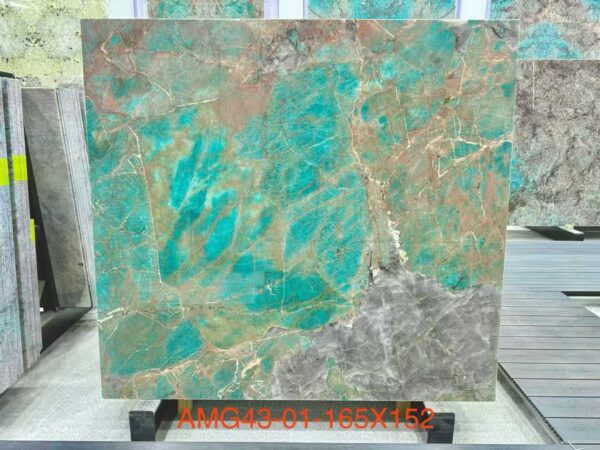
A recurring request is to supply this stone with the banding reduced or avoided. It is worth explaining why that is the wrong instruction, because we have seen what it leads to. The banding is not something sitting on top of the colour. It is the reason the colour reads as depth rather than as paint.
What the banding actually is
Quartzite forms from sandstone under heat and pressure. Minerals carried in the original sediment rearrange as the rock metamorphoses, and the ones that concentrate into visible streaks are what you are seeing. They run with the stone rather than across it, and they appear at different scales from slab to slab.
Because the banding is structural, it cannot be polished out, filled out or selected away without removing the material itself. A slab with no visible banding is generally a slab with less of the character that got it specified.
What happens when you ask for it removed
You end up buying from the narrow end of the range and paying for it. The slabs chosen to avoid banding are the plainer slabs, and a plain slab in this stone is rarely worth the premium the colour would otherwise command. Buyers who order that way sometimes feel the selection was undeliverable, because the material delivered is technically what was asked for and not what was imagined.
The productive version of the same request is to ask for banding that behaves well across the surface you are covering. That is a question about layout, not about purity, and it has a real answer.
Layout is the lever that actually works
For a feature wall, the useful instruction is a book-matched pair with the banding continuous across the seam, cut so the strongest figure falls where the room needs it. For a bar top, it is matching the two halves either side of a cut, or selecting a slab where the figure runs along the length rather than across it. For tile, it is accepting that each piece differs and letting the repetition of format carry the surface instead of the pattern.
All of those decisions are made against a specific set of slabs, which is why we would rather show you the slabs than promise a character grade.
Where this leaves a specification
If you tell us the form and the surface area, we will select slabs as a set and tell you how they were chosen. Quotation is against a lot, not a catalogue reference.
Questions this article answers
Where does Amazonite Quartzite come from?
From the Paraiba region of northern Brazil. The supply comes from a restricted deposit, which is why it is quoted lot by lot rather than as a standing stock item, and why a run for a single installation is matched before anything is cut.
How is Amazonite Quartzite usually used?
As a statement surface: mitred waterfall islands, luxury kitchen and bar tops, book-matched feature walls, and small-format backsplashes. The strength of the colour is the reason it is specified in one place rather than throughout a room, and a waterfall is the application that shows the movement best because the mitre presents two faces at once.
Filed under Matching