The workshop behind a stone that cannot be swapped
Amazonite Quartzite is bought slab by slab, and no two slabs carry the same movement. That makes the workshop the part of the job that decides whether the delivery is usable: a book-match planned on screen is worthless if the slabs that arrive are not the slabs that were approved. Everything below exists because this stone is specified by its veining, not by its size.
Sourcing by the lot, not by the container
This stone moves in lots. We buy at lot level rather than taking whatever a shipment offers, because the colour density and the direction of the veining decide what a run can become. Two lots can both be correctly described as Amazonite Quartzite and still sit badly side by side — which is the single most common complaint we hear from buyers who sourced it elsewhere.
Blocks are processed across <strong>Shuitou</strong> in Fujian and <strong>Yunfu</strong> in Guangdong, and we work in both. Shuitou is the export hub closest to the load ports; Yunfu carries the deep slab and cut-to-size capacity. A block is allocated and graded by us before a factory is booked, and our own people are on that floor while the job runs.
- Lot-level selection before cutting, not after
- Slab run matched for colour and veining direction before layout
- Two production clusters used as one supply base
- Load ports: Xiamen, Quanzhou, Ningbo or Shanghai
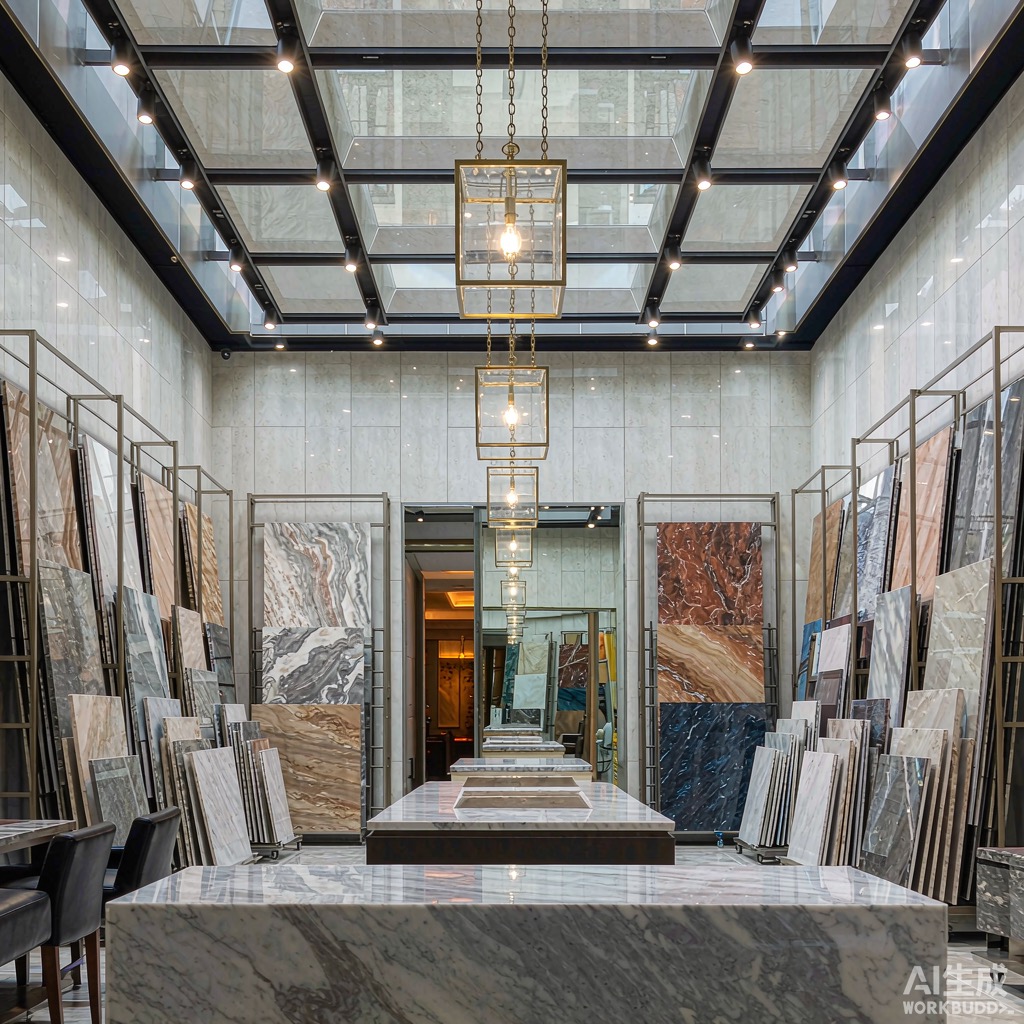 Slab run selection — matched before layout, not after
What decides the finish on this stone
A polished Amazonite reads deep and almost lit from inside; a honed one is softer and shows fingerprints less. The same slab takes a different character in each, so the finish is chosen per slab rather than per project.
Block sawing & gangsaw
Rough blocks opened on the veining rather than against it. On a stone whose whole appeal is movement, the cut decides which face is worth showing.
Resin line
Surface reinforcement before polishing. The step that decides whether a slab reads as premium or as ordinary.
Calibrating & thickness
Thickness held across the slab so a waterfall or island top can be booked by nominal size without surprises at installation.
Waterjet & CNC cutting
Sink cutouts, mitres and inlays from the approved drawing. Cut-to-size in this stone is usually driven by matching a run, not by a simple rectangle.
Polished & honed finishing
High polish for the full colour depth this stone is bought for; honed or brushed where a softer surface suits the room.
CAD / 3ds Max / BIM nesting
Book-matched layouts nested and optimised before anything is cut, so the pairs land where they were drawn and yield is planned rather than discovered.
Who handles your order
Described by role, not by a job title. On a colour-led stone, the person approving the slab run matters as much as the one cutting it.
Lot sourcing & allocation
Selects the lot, grades the bundle and matches colour and veining direction across the whole run before a factory is booked.
Slab run approval
Sends the matched run photographed side by side, so you approve the actual stones rather than a reference image.
Factory liaison
Sits with the factory on the job, translates the drawing on the floor and flags problems while they are still cheap to fix.
Quality control
Checks thickness, calibre, veining, polish and finish batch by batch, and photographs the records so you can inspect them before shipping.
Pre-loading inspection
Checks the actual pieces against your approved run before the container is sealed, so a mismatch leaves in China rather than at your warehouse.
Export documentation
Commercial invoice, packing list, certificate of origin and loading report — prepared in English, issued with the shipping documents.
Numbers you can check
Published trade values for this stone, quoted so you have something to compare us against. Absorption, flexural and compressive figures are typical published ranges rather than our own certificate — ask for the test report on our current lot and we will send it.
granite & marble Hardness Resists heat and everyday scratching; quartzite in character, not a marble that has been promoted
We do not publish a price list. This stone is quoted slab by slab, because the grade, the size, the thickness and the polish all move the number, and a single figure printed on a website is wrong by the time you read it. Published North American slab pricing for Amazonite Quartzite runs from roughly USD 5,800 to over USD 18,000 depending on thickness and dimensions — send us a thickness, a size, a quantity and a destination port and we will quote FOB against that specification.
How a job actually runs
From the moment you send a requirement to the moment the container closes. On this stone the sequence matters more than usual: the slab run has to be approved before there is anything to cut.
Requirement received
Form, thickness, quantity, destination. We confirm which lots are available and quote FOB against them.
Slab run issued
The matched run is photographed side by side and sent for approval, with a book-matched layout in 3D / BIM / CAD.
Production & QC
Cutting, finishing and batch-by-batch QC on site, with progress photographs as the job moves.
Pre-loading inspection
Every piece checked against the approved run, then supervised container loading with a seal number issued.
Documents handed over
Invoice, packing list, certificate of origin and loading report, with freight options quoted side by side.
What we will not do
Trust is easier to believe when a supplier tells you where the line is. Ours is below.
We do not mix lots to fill an order
A run that has to come from two lots gets quoted as two lots, with the difference stated. Filling a gap from a different lot is how a book-match fails on site.
We do not pass your details to the factory
Your drawings, quantities and destination stay with us. The factory is told what to cut, never who it is for.
We do not ship uninspected to save a week
If pre-loading inspection finds a mismatch, the piece stays in China. A faster delivery of the wrong stone is not a delivery.
We do not quote a stone we cannot supply
One variety, handled completely. If the lot or the form is not there, we say so rather than substitute quietly.
Send us the run, not just the stone name
Tell us the form, the thickness, the quantity and the destination. If you already have a drawing or a photograph of the colour you are chasing, send that too — it is the fastest way to put the right lot in front of you. A supplier who cannot tell you which lot your slabs come from is not sourcing, they are forwarding.