Colour
Book-Matching Amazonite Quartzite: What the Guarantee Covers, and What It Does Not
A book-match is two slabs cut as mirrors. What that guarantees, what it cannot fix, and why we cut the pair before the job is booked rather than after.
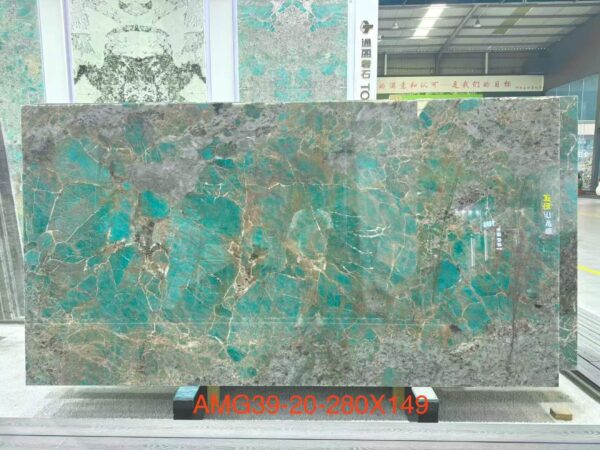
A book-matched waterfall is the reason a great many buyers end up looking at Amazonite Quartzite in the first place, and it is also the specification most often written in a way that cannot be delivered. “Book-matched, 20 mm, waterfall island” tells a supplier very little. What actually decides whether the job works is whether the two slabs were cut from the same block, at the same time, in the same orientation — and whether anyone checked that before the island was booked.
A book-match is a cutting instruction, not a product
Nobody sells book-matched slabs as a separate product. Book-matching is an instruction you give the saw: cut two slabs from adjacent positions in the same block, mirrored, so the veining continues across the join when they are butted together. That is the whole mechanism.
The consequence is worth being blunt about, because it is where jobs go wrong: a book-match cannot be created after the slabs are cut. If the two slabs in the job did not come from the same block in mirrored positions, no fabricator, no resin, and no installer can make them match. The pattern either flows or it does not.
What we do before the island is even dimensioned
Because of that, the sequence matters more than the promise. On this stone the run is selected before cutting, not after, and it is photographed side by side in daylight before anything goes to the saw. What we are looking for is not two pretty slabs. It is two slabs whose movement continues in the same direction and at the same density across the joint.
On a colour-led stone this is harder than on a uniform one, and that is the honest reason we quote this stone by the lot. Two lots can each be individually excellent and still be wrong for each other. Buying “two book-matched slabs” without agreeing the run first is how a project ends up with a waterfall that does not flow.
The mitre is where this stone earns its price
A waterfall island is normally mitred, which means the stone turns the corner and two faces are visible at once, meeting at a 45-degree line. On a stone with movement in it, that line becomes the single most demanding joint in the project: it shows any mismatch between the two faces immediately, and it doubles the apparent depth of the pattern.
This is also why thickness enters the conversation. A 30 mm stone mitred at the corner reads as a solid mass; the same stone at 20 mm mitred reads as a folded sheet, and the joint line dominates. Neither is wrong, but the choice should be made with the mitre in mind rather than after seeing a sample.
Send us the island dimensions and we will tell you which gauge we would cut, and whether the run currently in the yard suits the span. Sometimes the honest answer is that the layout needs to change, because the matching pair you want is a different size.
What to ask for in writing
Three things, and they are all checkable before anyone cuts stone. First: that the two faces come from one block, named. Second: photographs of the two slabs side by side, in daylight, at the joint line. Third: confirmation of which face becomes the mitre, because a mirror has a left and a right and the island has a front.
If a supplier cannot answer all three, the book-match is a hope rather than a specification. We would rather lose the order than take one on those terms.
Questions this article answers
Where does Amazonite Quartzite come from?
From the Paraiba region of northern Brazil. The supply comes from a restricted deposit, which is why it is quoted lot by lot rather than as a standing stock item, and why a run for a single installation is matched before anything is cut.
How is Amazonite Quartzite usually used?
As a statement surface: mitred waterfall islands, luxury kitchen and bar tops, book-matched feature walls, and small-format backsplashes. The strength of the colour is the reason it is specified in one place rather than throughout a room, and a waterfall is the application that shows the movement best because the mitre presents two faces at once.
Filed under Colour